 Spanish
 Portuguese
Talented helps you build an understanding of music theory rather than teaching you how to play a couple of songs on a specific instrument.
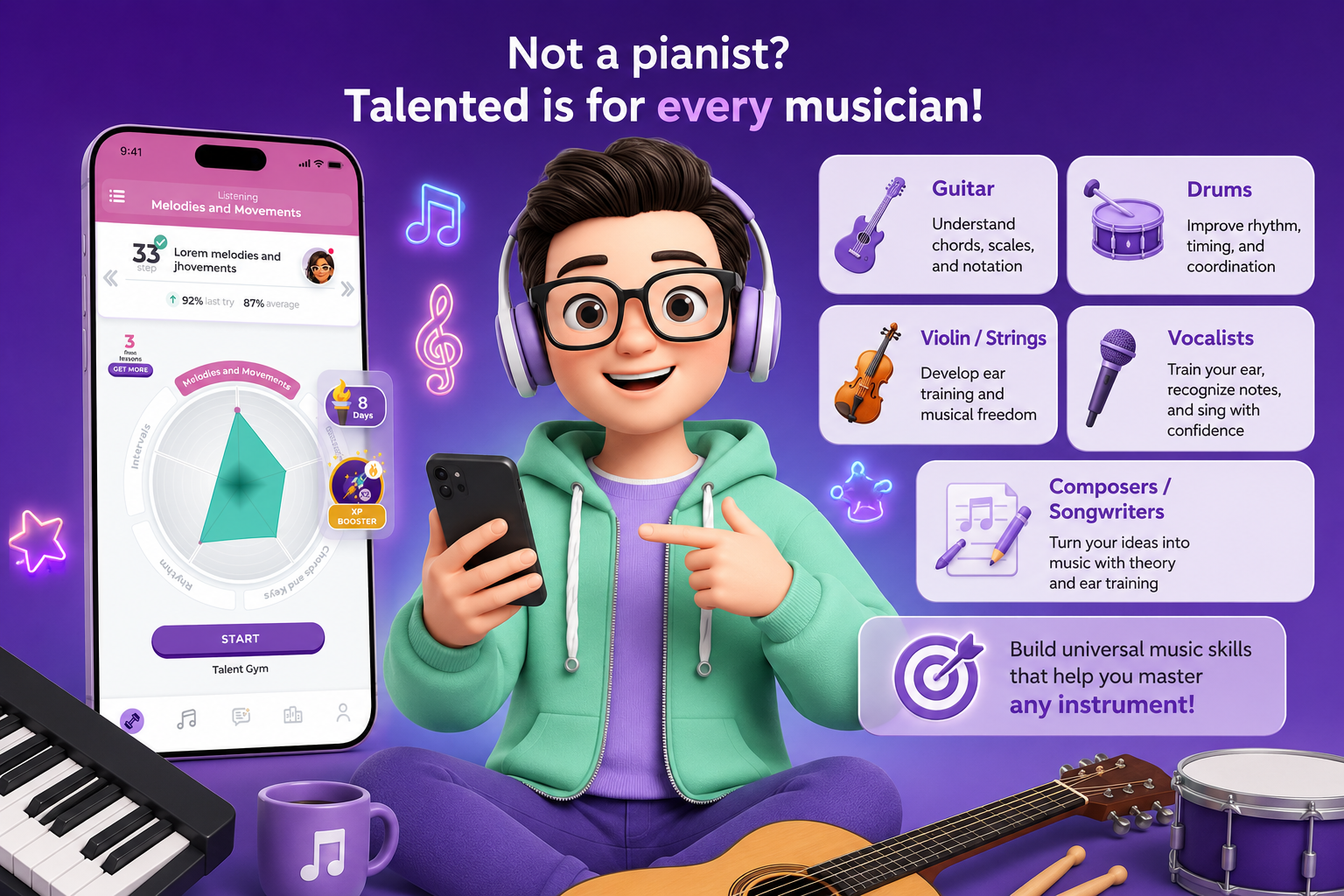
The app doesn’t teach a specific instrument skill, like guitar finger placement or drum stick control, but focuses on more universal music skills. With Talented, you can build a foundation in music theory that will help you with learning any instrument later on.
No matter the instrument you are playing or want to play, Talented will be helpful
Here are Talented features that can be most useful to you, based on your instrument or music field:
Guitar
Many guitar players rely heavily on tablatures and don’t want to learn traditional notation. Tabs may be a great way to start, but they can limit your ability to understand the instrument.
Not to mention, fewer songs or melodies have tablatures, compared to traditional notation.
Bonus: If you understand music notation, you’re much more likely to be able to:
- improvise
- understand your favourite songs
- play them by ear
- transpose them if they are not written in your key
Talented gives a basic music understanding that helps you learn guitar better and faster.
Drums
Sense of rhythm is one of the most — if not the most — important elements of drum playing.
Talented has an entire section dedicated to learning and understanding:
- rhythms
- melody
- intervals
It’s important to know music theory to be able to play freely, improvise, or even write music.
In addition, Talented offers exercises that develop both rhythm recognition and reading skills, as well as fundamental rhythmic coordination. Those lessons help improve timing, groove, and internal clock — which are core to drumming. And like guitar players, drummers can benefit from music theory and traditional notation lessons.
And like guitar players, drummers can benefit from music theory and traditional notation lessons.
It’s important to know music theory to be able to play freely, improvise, or even write music.
Violin / string instruments
Classically trained players often have a developed musical ear and read sheet music well, but may lack improvisation.
Talented offers the tools to further develop those skills and helps you build musical freedom:
- playing by ear
- recognizing patterns
- understanding what’s behind the notation
Vocalists
It may not be obvious, but singers are a group that can benefit the most from using Talented.
Unlike instrument players, vocalists aren’t able to utilize the:
“see → repeat”
When you have only your voice as an instrument, it may be tricky to visualize and understand how to extract the right note.
The only way to sing accurately, consistently, and confidently is to develop musical literacy and a trained ear.
Talented provides the foundation for it:
- train your ear
- recognize notes and intervals
- better understand musical structure
Talented virtual piano complements the process by helping you understand and memorize notes and chords visually, which can improve your vocal control and musical awareness, therefore increasing your confidence and overall level of performance.
Composers / songwriters
Writing music is the highest form of musical art, and it requires a deep understanding of music theory.
Without proper music knowledge, you may:
- come up with strong ideas
- struggle to develop them
- find it difficult to explain them
- fail to recreate them consistently
This usually comes from gaps in:
- core music theory
- ear training
With the core music skills Talented helps you acquire, you can finally turn your concepts and ideas into finished melodies.
You’ll be able to create music with a deeper understanding of what, why, and how you’re doing.
Recommendation
If you’re not currently practicing playing an instrument or singing, we recommend starting to do it either:
- simultaneously with Talented
or - shortly after beginning lessons (1–3 months)
Playing an instrument immediately puts into practice what you learn in the app.
Likewise, developing your skills with Talented helps you better understand what you’re doing on the instrument, gives you more freedom, and accelerates your progress.