 Spanish
 Portuguese
Learning music can be intimidating. Most of the time, you miss keys, mix up chords, or don’t feel the rhythm at all.
If you’ve just started using Talented and feel like not everything is clicking from the start — that’s not a sign that something is wrong. It’s actually a very typical stage of learning music. Many students expect quick results, but music is a complex set of skills that takes time, repetition, and focus to develop.
At first, you might feel like some exercises are too difficult: you don’t recognize notes, you can’t hear the difference between sounds, and some steps feel impossible to pass.
Don’t feel discouraged — this is a part of the process, and you learn from mistakes.
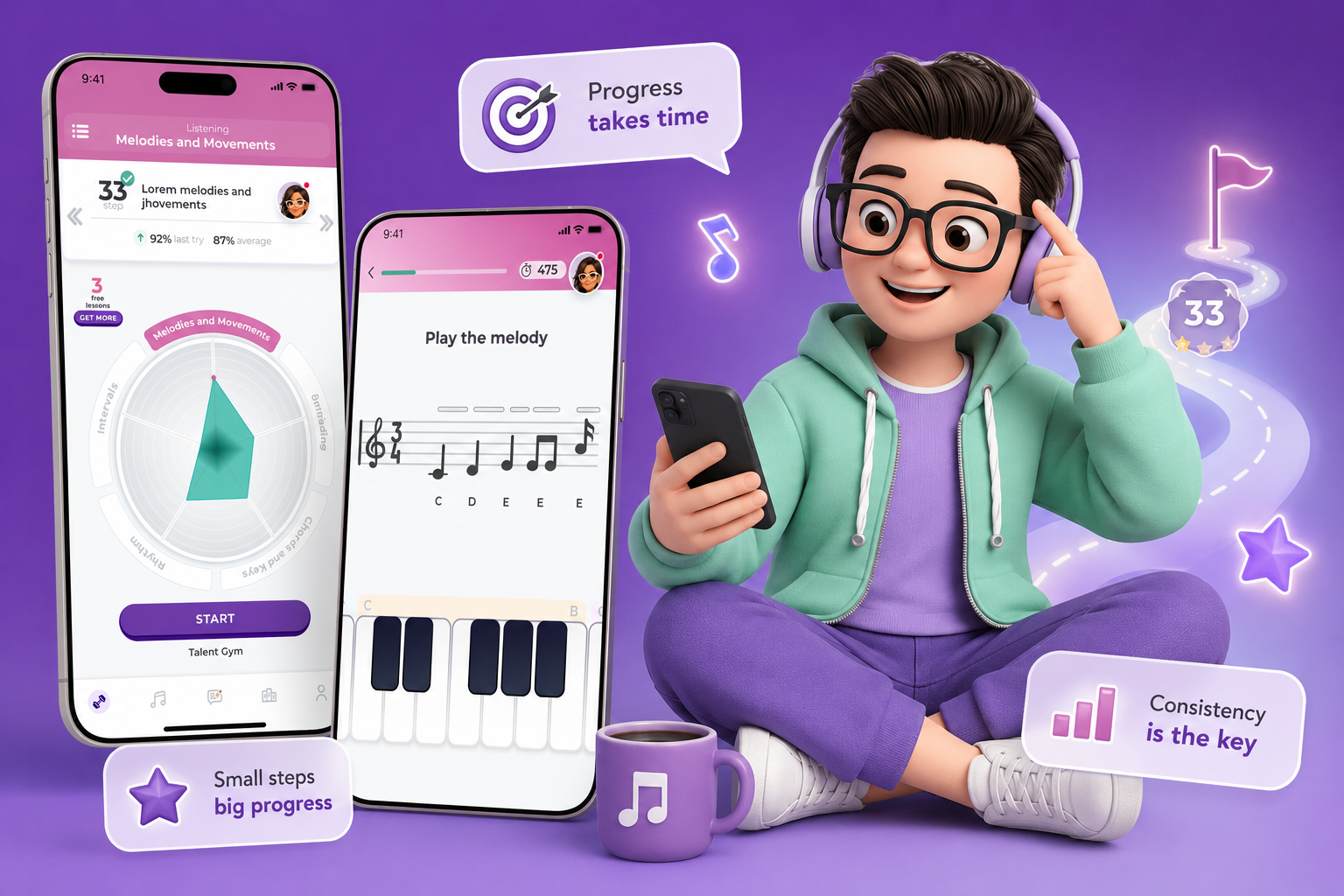
Why does progress feel slow?
One of the hardest parts of learning music is that progress is not always noticeable.
Your brain is building new neural pathways in an area it’s not used to. This takes time, and the results don’t always show immediately.
The typical learning curve looks like this:
improvement → plateau → breakthrough
Sometimes you improve quickly. Then comes a long phase where it feels like nothing is changing. After that, suddenly, something “clicks.”
These plateaus can last weeks or even longer. But if you keep practicing attentively, progress will come — often unexpectedly.
I’m stuck on a step and can’t pass it
This is especially common in Talent Gym. You might get stuck on intervals and think:
“How am I supposed to hear the difference? I just don’t hear it.”
That’s normal.
Talent Gym is built specifically for this situation. The goal is not to get everything right immediately — the goal is to train your brain through repetition:
- you listen
- you choose an answer (even if you’re unsure)
- you get feedback
- your brain starts forming connections
At first, it feels like guessing. Then you start getting things right slightly more often. Then you recognize patterns.
Eventually, what once felt impossible becomes obvious.
This process can take time — sometimes weeks — but it works.
Why repetition is the key
Skills like ear training or rhythm are not learned through explanation — they are learned through repetition.
Each lesson or practice session strengthens your perception, improves recognition, and eventually builds automatic responses.
Over time, your brain moves from conscious effort (“I think this is correct”) to automatic recognition (“I just hear it”).
This is when learning starts to feel easier.
Why are some skills harder to learn than others?
You might progress quickly in melodies but struggle with chords. Or rhythm may feel easy while note reading feels difficult.
That’s completely normal.
Everyone develops musical skills at a different pace, but all of them require:
consistent practice + repetition
How to move forward when you’re stuck
If you feel completely lost or frustrated, try to:
- go back a few steps and repeat earlier material
- slow down
- focus more carefully during exercises
Music understanding is not a quick skill to acquire. Sometimes you simply need more repetitions than expected — and that’s okay.
How much practice is actually needed?
With music learning, consistency matters more than quantity.
1–2 lessons every day is far more effective than
10 lessons once a week.
Even 10–15 minutes of daily practice is enough to:
- keep your brain engaged
- strengthen neural connections
- create steady long-term progress
After a while, you’ll notice that mistakes have become less frequent, lessons are easier to comprehend, and overall playing quality is much improved.
It’s important to keep at it. Do not get discouraged by first mistakes.